
Stop Guessing. Start Detecting.
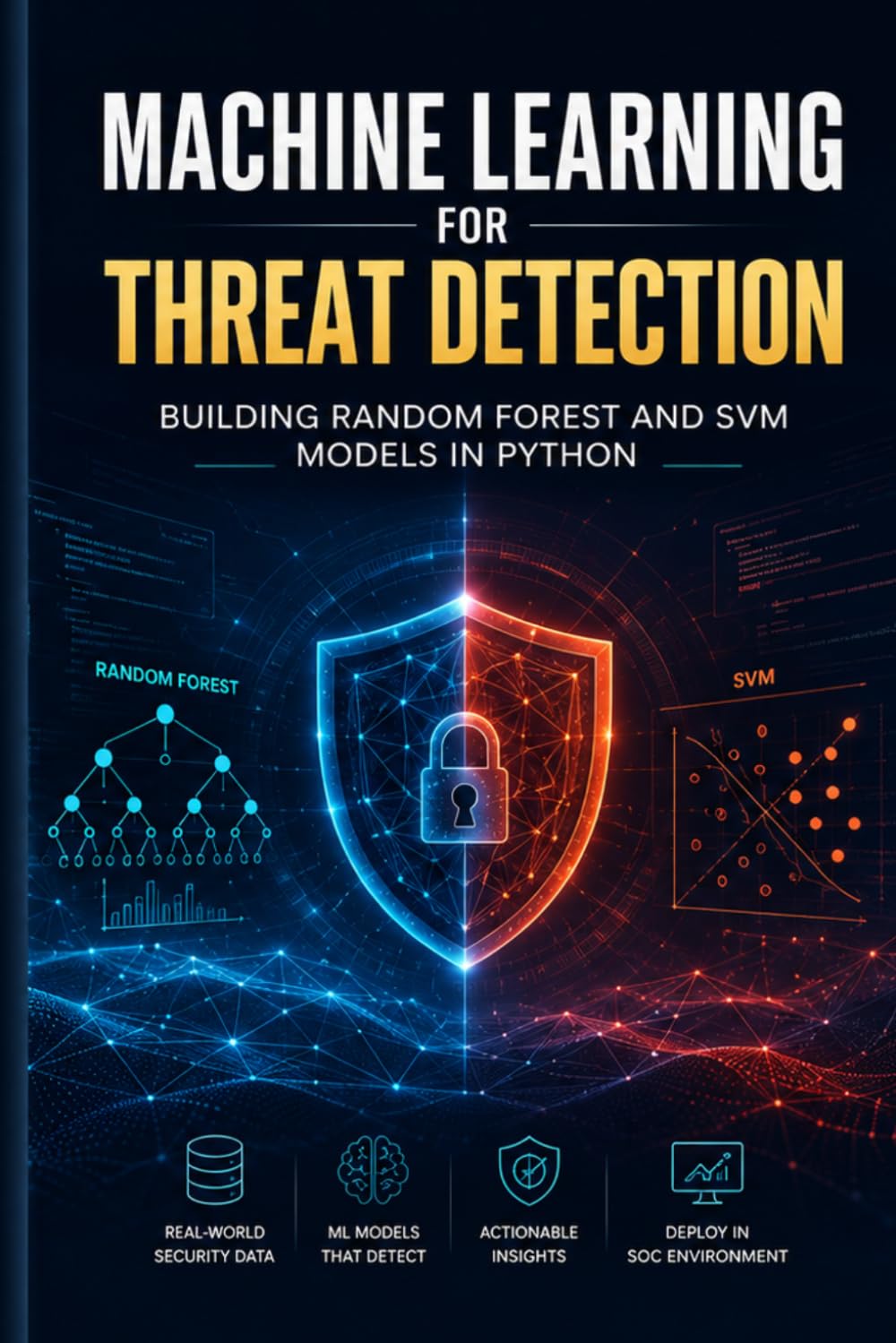
Machine Learning for Threat Detection: Building Random Forest and SVM Models in Python is the hands-on guide that takes you from raw security data to production-ready intrusion and malware detection models—using Scikit-learn, Pandas, and real SOC workflows.
Why This Book Changes How You Defend Networks
Move beyond static rules. Deploy intelligent defense systems.
Hands-On, End-to-End ML Workflow
Move beyond theory. Follow a complete pipeline—from data cleaning and EDA to feature engineering, model tuning, evaluation, and deployment inside a simulated SOC environment.
Battle-Tested Algorithms for Security
Master Random Forest for network intrusion detection and Support Vector Machines for malware traffic classification, with real datasets.
Built for SOC Analysts and Engineers
Every metric, confusion matrix, and ROC curve is explained through the lens of a Security Operations Center analyst, so you can act on model output.
Production-Ready Python Skills
Learn to use Scikit-learn, GridSearchCV, Pandas, NumPy, and Matplotlib to build models that outperform static signature-based detection.
Inside the 11 Chapters
From raw security data to production-ready models.
The Threat Landscape and Machine Learning’s Role
Discover why rule-based detection is falling behind and how ML is reshaping modern cyber defense.
Setting Up Your Security ML Lab
Install and configure Python, Scikit-learn, Pandas, NumPy, and Matplotlib for security-focused machine learning.
Exploratory Data Analysis for Network Intrusion Data
Learn how to load, inspect, visualize, and understand network intrusion datasets before modeling.
Feature Engineering for Security Data
Transform raw security logs into meaningful features that boost model accuracy and detection power.
Random Forest for Network Intrusion Detection
Build your first production-ready Random Forest classifier to detect network intrusions.
Hyperparameter Tuning Random Forest with GridSearchCV
Optimize Random Forest performance using systematic hyperparameter search and cross-validation.
SVM for Malware Traffic Detection
Develop Support Vector Machine models designed to classify malicious versus benign network traffic.
Advanced SVM Tuning and Kernel Tricks
Master kernel selection, parameter optimization, and advanced SVM techniques for complex security data.
Model Evaluation and Interpretation for SOC Analysts
Measure success with precision, recall, F1-score, ROC curves, confusion matrices, and feature importance from a SOC perspective.
Deploying Models in a Simulated SOC Environment
Integrate trained models into a realistic SOC workflow for automated, practical threat detection.
Conclusion and Next Steps in Security ML
Consolidate your skills and explore the next frontiers of AI-powered cybersecurity.
What Readers Are Saying
Finally, a cybersecurity ML book that actually shows you how to build and deploy models instead of drowning you in math. The SOC-focused evaluation chapter alone is worth the price.
I went from basic Python to tuning Random Forest and SVM models for intrusion detection in a weekend. The step-by-step code and real datasets make all the difference.
This is the bridge between machine learning theory and real security operations. If you want detection models that matter, start here.
Choose Your Format
Build smarter, faster, more accurate security solutions.
Kindle Edition
- Instant digital delivery
- Read on Kindle, tablet, or phone
- Searchable, portable reference
- Copy code snippets with ease
Paperback Edition
- Physical book for your desk or lab
- Annotate, highlight, and bookmark
- Perfect for hands-on study sessions
- Durable reference for daily SOC work
Start Building Threat Detection Models That Matter
Join cybersecurity professionals who are replacing static rules with intelligent, ML-driven detection.
Buy Now on Amazon